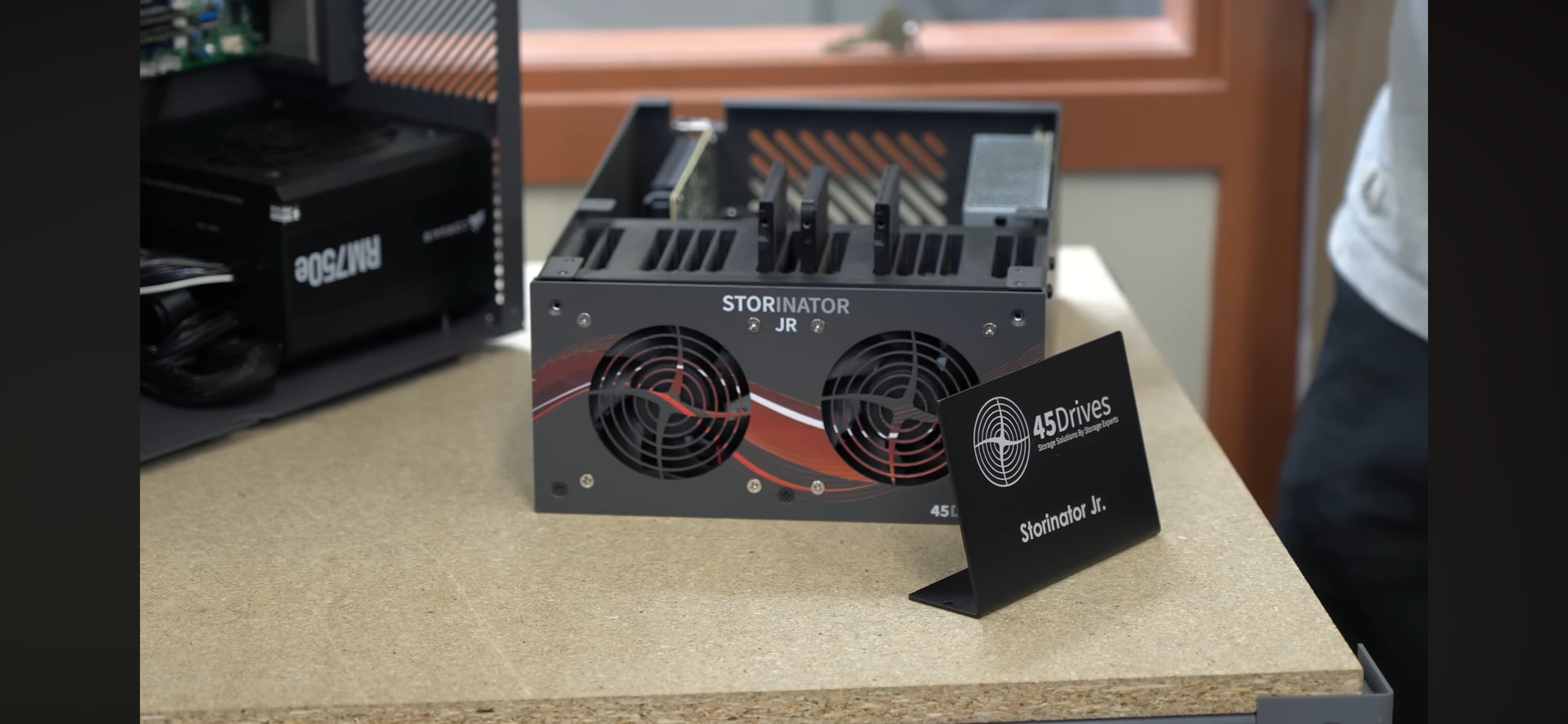
45HomeLab was built to bring the same over-engineered quality of our 45Drives enterprise servers into the homelab world, rugged 16-gauge cold-rolled steel, premium components, and hardware made in North America.
We love this community. The creativity, the builds, the passion, it’s what makes this space so much fun. And because you’re the ones actually using this gear, we want to hear from you:
More storage? More compute? A quieter design? A new form factor? Something wild?
Your input has already helped shape the HL15 beast, the HL8, and many other products.
Big thank you to this incredible community. Every idea, every build, every bit of feedback helps make our homelabs better.
Tell us what would make your setup even better. Your ideas shape what we build next.
2.5” NVME! Even just an option for 4-8 bays with a backplane. The Epyc board that is available has the PCI-E lanes; just need a card and mounts for them.
A case that supports dual or quad systems, with 2-4 ITX boards in a 5U or 4U case and an HL15 disk shelf. Home lab cluster in one box.
Expand the store to offer a larger selection of ready-made customer faceplate options. When people order something cool, give them the option to share the design with the community so that we can one-click order.
Ask 100 homelabbers, you’re going to get 150 different answers.
I’m the opposite of @jrhenderson. I don’t want some hyperconverged behemoth. Although I don’t say those requests are invalid (I had a Q30 years ago). I’m too old to lift heavy cases into racks, especially with those awful Supermicro rails. The Beast started out promising but ended up way too big and heavy for me personally, although I think it is a decent product offering for the community.
There seems to be a lot of desire for enterprise-grade SSD support for existing hardware; U.2/U.3 15-mm and EDSFF. Off the top of my head, that’s where I’d suggest focusing some energy.
For me, I’d prefer variants of the HL15 form factor. Specifically, one optimized for compute. Something like allowing the PCIe slots to go the full length of the case, with the drives area only in front of the CPU area of the motherboard. It could have something like 8 or 9 HDDs, but probably better would be a SSD-only tri-mode backplane allowing 7mm and 15mm drives. An SSD-only backplane would also allow for larger motherboards, although perhaps not EATX. You could keep it a 4U, but I’d do 5U for the taller GPUs. So, 5U but only 20 inches deep like the HL15 and the backplane on the right only to where the first PCIe slot starts.
So, you’d have an HL-15 sized chassis with two ITX motherboards but little or no HDD storage? What is your use case, HA, or space reduction? What is your use case vs a single motherboard with more powerful CPU? How powerful are you expecting the ITX boards to be and what do you expect to be able to do in the PCIE slot? Are you wanting to run large GPUs, or just a possible simple 1-slot GPU for transcoding, or an m.2 riser card for storage?
Or are you intending to use the PCIe slot for an HBA out to the disk shelf. I think the probability of 45HL doing a disk shelf is very low, although I think it has a bit more merit in the homelab than on the enterprise side.
I think one issue might be power (which is why I asked about HA). Are you expecting to run both motherboards off of one PSU with ATX/EPS splitter cables, have dual PSUs, or have a dual mobo PSU like the discontinued Phanteks Revolt X? If dual PSU, what wattage would you need per mobo; would SFX be sufficient, or are you looking for a full ATX supply for each board? The power distribution gets even more complex if you are trying to do four ITX boards with consumer, not custom, components.
I can see having multiple systems in one chassis has it’s applications, but it seems like you’re giving up a lot in the way of PCIE and compute flexibility given the state of virtualization these days.
I am looking for “denser” options from 45HomeLab. I’m looking more in the terms of compute but would like enough storage to run Ceph clustering. Going with a 2U chassis is one option but a 4U dual system could meet the same need in a similar amount of rack space.
In my opinion, HA always sounds better than what it actually ends up being; especially when done at the hardware level. At least a dual system option can actually be used as two systems versus most HA setups. You’re really only using one system at a time and paying for the peace of mind through the extra hardware.
The idea for a multi-system case was just something I was putting out there for others. I have observed that many home labers seem to like cramming many small, cheap 1 liter systems into clusters. I don’t have a use case for it at all, just making suggestions.
Personally with the HL15 2.0 or HL15 Beast that covers my needs for the active VM/Docker NAS. On-Hold due to crazy RAM pricing…
I was looking at the Sliger 3U or 4U with 360 AIO for compute/game server AM5 nodes. Got one low power node going for testing before the RAM price hike.
My only other item still to work out is a backup solution NAS to backup all of the other devices. Was thinking a HL30 would be nice, or seeing if I could find a used Q30 at a decent price. Does not need much, could be AMD Epyc 4004/5 65w based ASRock B650D4U3-2L2Q/BCM with a riser splitting the 16x down to two 8x slots for HBA cards. As same IPMI as the ROMED8-2T and it already has 2x25GB SFP28. But from researching probably will have to have Dual/custom PSU to pull that off for any HL30, hence the mATX with two low profile HBA cards and one NVME card to run Raid 1 for OS drives.
There’s a Q30 on eBay of the direct-wired but not backplaned generation. I think it has LSI HBAs and not Highpoint (which is good), but you’d have to confirm. You’d want to confirm what’s included as there is some stuff in the photos not enumerated in the text description. You’d probably also want to negotiate on price. Make him understand these units are EOL for a number of reasons.
For more than 16 HDDs you might be better considering a Supermicro CSE-846 or CSE-847. I’m planning to turn a second HL15 chassis into a disk shelf. Not the most efficient use of space or money, but it maintains the aesthetics in the rack and is lighter.
My daily driver is an M1 iMac. For storage I have an HL4 and 2 TrueNAS Minis. Since I don’t collect video (just stereo recordings), these small 4 bay systems are enough.
I’m running into a storage dilemma, Parkinson’s law keeps coming for the hard drive. I’ve had to move the music and photos off the 2 TB system volume. They’re on a LaCie 2 TB external volume.
What I’d like is an ITX based system with ECC and room for say 8 2.5 inch drives in a compact package, say the size of a Ubiquity UniFi UNAS Pro or UNAS 4. UniFi UNAS Pro - Tech Specs
An alternate idea would be a compact Thunderbolt 4 storage enclosure with an SD slot and some USB-C USB4 ports for mouse and keyboard charging and SD card chores. I know OWC has been there but nothing is low profile.
Perhaps a 1 or 2 U modular server with a focus for storage. In my case, I would use it as a backup device for replication of pools for my HL 15. A tri-mode backplane supporting modular units for HDD, SSD and NVME would be superb. Low power consumption would be another desired attribute.
I like @phos thinking a 1 or 2 u chassis/server would be great. The recent VM 2 proxinator what was released a few days ago looks really interesting. And personally would love to see that on offered on 45homelab.
I think that is a good unserved segment. You are probably more focused on consumer SSDs, but I would propose it as a HL version of a “Stornado F8”. An all-flash design using their latest slot design, but with not enough slots to have it be of interest to the Enterprise. I’m not sure without refreshing my memory what tech they use in the F16, but I think the issue with an ITX board would be around connectivity and maximizing the performance of the 8 SSDs. Remember that a PCIe slot can only support 4 NVMe SSDs with bifurcation. There are ways around that with muxing and so on, that might serve your need, but at the high level the product here would probably want to stick to the 4 PCIe lanes per SSD architecture and not one that effectively reduces the bandwidth to, say, 2 lanes of PCIe per SSD.
They don’t meet all your specs, but are you aware of the all-flash NAS products like the Asustor Flashstor, Terramaster F8 SSD, QNAP NASbook and Beelink ME Mini?
If it’s possible at a good price, I would still like to see “upgrade kits” for us HL15 v1.0 owners that would include the motherboard, cpu, hba, etc. of the HL15 2.0.
Not shopping for anything you don’t already make right now, but if I had the spare money, I’d be interested in a 2U VM machine similar to the Proxinator VM2 with a GPU option, 8-64C CPU options, and something like 8 M.2 NVMe drive slots and some 10GBe networking by default with options for 25G and 100G. This may not be feasible or popular, even if possible, since it seems many would rather have more expensive storage solutions for a VM, such as U.3.