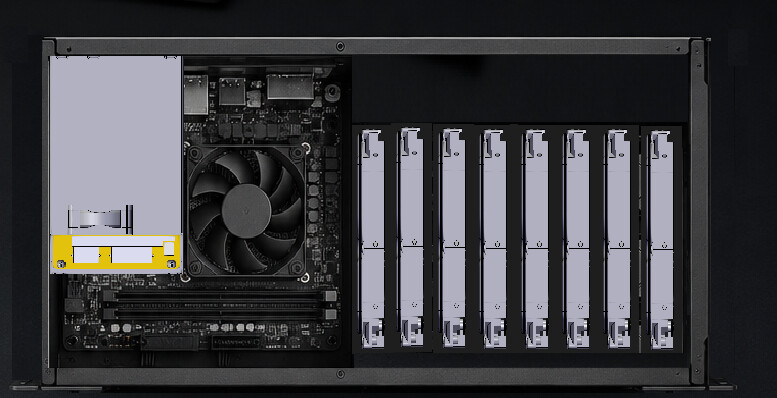
We’d love to get some feedback from the Unraid community regarding potential chassis designs for smaller form factor systems for our X8 or X4-style platform.
At this stage, we’re specifically looking for feedback around the physical chassis design only — not electronics, backplanes, or internal hardware configurations. We’ve seen growing interest from Unraid and homelab users looking for compact, high-quality enclosures that maintain the same build quality and aesthetic as the larger 45HomeLab systems.
We’d love to hear what you would personally find valuable in an X8 or X4 chassis design for Unraid builds.
Some things we’d love feedback on:
Rackmount vs desktop/tower preference
Compact vs full-depth chassis
Quiet airflow/cooling design
Front panel styling and aesthetics
Easy drive access
GPU/transcoding support
ATX / mATX / ITX compatibility
Cable management ideas
Hot-swap vs internal drive mounting
Premium features you’d want in a homelab chassis
Features missing from current Unraid-focused cases on the market
If we were to develop a smaller Unraid-focused chassis, what would make it appealing to you?
Feel free to share:
Photos of chassis you like
Sketches or concepts
Wishlist features
Frustrations with your current case
Ideas you think would fit the 45HomeLab style
We’d really love to hear the community’s thoughts and ideas!
Not Unraid specific, but I think this is really where the HL4/8 trail other cases. I do appreciate the thought that went into the HL4/8 but the single-width half-length slot seems rather restrictive compared to other cases on the market. You might want to look at what you could do starting with an internal layout more like the Fractal Node 304 except allowing for at least 2.5 slot width cards.
Modular construction with clip together or stay apart module - so separate pieces for drives, mobo, RAM with specific cables for busses connecting to sockets (e.g. 10GBPS USB-C but with clips to “lock in” the male to female). This would aid the solutions for the number 1 problem of ventilation for heat removal. The cables could be of varying length to aid the customer in deciding on the optimum location for each piece. Allow many more slots for RAM since Unraid is a RAM only OS (ones of its main strengths along with the HDD management) - work with engineers to develop RAM management solutions to allow RAM of different types and speeds to be aggregated as one RAM pool - perhaps the people at Unraid could help here since the do the same for HDD’s. With the amount of energy consumed by current server set-ups (more powerful in what they accomplish but also more powerful in what they consume) air cooling does not work for homelabs. You could also just come up with a frame/rack that would take your chassis and fit them in a customized (power into the cabinet) bar fridge (Ivation 126 Can Beverage Refrigerator on Amazon for $200 for example).
I will share my thoughts, but I need you to know I am not a graphic or 3d designer by any stretch of the imagination. My simple “napkin” math says this could work but I’m probably missing something.
The idea is this:
3U, short depth.
Drives load from the front so that rails are not required, but instead optional.
Chassis divided into 2 parts, 1-part drives and backplane, other side is the ITX MOBO.
1u Flex PSU mounts above the MOBO, low profile RAM and cooler would be required.
Top down view:
Not to scale obviously. Just putting the “rough” idea in image form.
I would have thought a main issue with this would be the loss of the PCIe slot, but I’m not an Unraid user and no longer usually an 8-bay chassis user.
I think the question would be, are people willing to pay premium prices for relatively low power machines? Perhaps, people were buying the HL15 with a Xeon Bronze 3204, but I’d think it’s a harder sell in the current economy. A low profile cooler will limit the CPUs that can be used, and a 3U height means 80mm case fans which will need to spin faster and be noisier to keep the machine cool, and no PCIe slot effectively makes this no more than a SATA/SAS NAS,.no extra NVMe cache, no GPU, no upgraded networking.
I definitely don’t claim to speak the gospel on this, but I want to offer a few counterpoints to keep the conversation going.
On the PCIe limitation, I think in a design like this you’re realistically looking at a half-height, single-slot card. That does limit you to something like a single HBA, NIC, or maybe NVMe expansion, but that’s already pretty in line with what we see in the HL4 and HL8 category. If someone needs multiple PCIe cards or more flexibility, 45Drives already has a solution for that with the HL15.
As for CPU cooling, I don’t see that as a major issue for the target use case. If you truly need a lot of CPU power, you’re probably shopping in a different product category anyway. Most NAS systems spend a lot of time idle unless you have a large number of active users constantly hitting it. And if you’re at that scale, you’re likely already looking at higher-end networking and more infrastructure. Which I feel again, points more toward something like the HL15.
On NVMe cache, I think it really depends on the workload. To get real benefit, you need a solid cache hit ratio. If you have that, you likely also have enough activity that a lot of that data is going to live in RAM anyway. Personally, I would prioritize more RAM over relying heavily on NVMe cache in most homelab or small production setups.
Just my perspective, and it’s probably a bit narrow. Most of my interaction with other homelab folks is online only, so I don’t have a lot of experience on the subject.
I might be a bit late for the discussion.
Anyway here’s my suggestion:
A rack chassis for the 10’’ rack form factor.
Those things have become increasingly popular for home users, with more and more compatible hardware becoming available, and a very active maker scene for 3d printed accessories.
I would think that a 45drives chassis maybe 3U tall and fitting ~4 HDDs would work quite well. The form factor is big enough for mini-ITX motherboards.